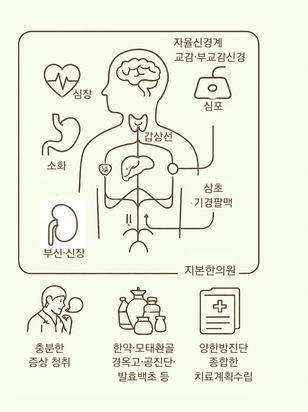
Summer Fatigue & Brain Fog: A Korean Medicine Approach
“My head feels foggy and I just want to lie down all day.”
“I sweat, but I don’t feel refreshed.”
If temperatures haven’t even peaked yet but you’re already exhausted, your body may be sending early warning signals about heat stress.
What’s Behind Summer Fatigue?
The Medical Facts
Early summer fatigue can be classified as mild heat stress. As temperature and humidity rise, the autonomic nervous system diverts more energy to thermoregulation, resulting in fatigue, reduced concentration, and appetite loss.
The Korean Medicine Perspective
Korean Medicine identifies this as “Gi-heo-bal-yeol” (氣虛發熱) — heat arising from energy deficiency — combined with “Cheong-seo-bul-li” (淸暑不利) — failure to properly clear summer heat. Essentially:
- Heat rises but body fluids (津液/jinye) aren’t replenished
- Energy (氣/gi) and fluids are consumed together during heat adaptation
- The autonomic system can’t fine-tune its responses
Three Natural Approaches
1. Lettuce (상추) — Cooling Heart Fire
In Korean Medicine, lettuce has a cold nature (寒性) that helps calm heart fire (心火). It also contains folate, which supports mucosal repair and energy metabolism. Best eaten fresh or lightly dressed with sesame oil and vinegar.
2. Omija (오미자/Schisandra Berry) — Gathering Energy, Preserving Fluids
Omija has astringent and fluid-generating properties. It’s effective for thirst, dry mouth, and excessive sweating. Rich in antioxidants and may support autonomic stability. Best preparation: Cold-steep 5–10g in 500ml water for 6+ hours in the refrigerator. Boiling may destroy some active compounds.
3. Saengmaek-san (生脈散) — The Classic Summer Formula
This traditional prescription contains ginseng, ophiopogon, and schisandra. It simultaneously tonifies energy (補氣), generates fluids (生津), and stabilizes sweating (止汗). In modern terms, it supports heart rate stability, fluid retention, stress regulation, and microcirculation.
Air Conditioning and Your Autonomic Nervous System
Repeatedly moving between cold indoor air and hot outdoor temperatures overloads the autonomic nervous system. Korean Medicine describes this as “Han-yeol-wang-rae” (寒熱往來) — alternating cold and heat attacks. We recommend keeping the indoor-outdoor temperature difference within 5°C and protecting your neck and abdomen from cold air.
Frequently Asked Questions
Is summer fatigue a real medical condition?
It’s not a formal diagnosis, but Korean Medicine recognizes and treats it as an energy-fluid imbalance. If symptoms persist beyond 2 weeks, professional consultation is recommended.
Should I drink lots of cold drinks in summer?
Naturally cool foods (lettuce, watermelon, omija) are beneficial, but ice-cold drinks and excessive ice cream can weaken digestive function, making fatigue worse.
Why is brain fog worse in summer?
Rising temperatures deplete body fluids and energy, reducing cerebral blood flow and destabilizing the autonomic nervous system. Adequate hydration, sleep, and Korean Medicine energy-fluid support can help.
Jibon Korean Medicine Clinic
Gwangju: Dr. Kim Tae-gang (Musculoskeletal/Motae Hwangol, 18 yrs) & Dr. Noh Jeong-eun (Autonomic/Circulation, 22 yrs, Ph.D.)
Jeonju: Dr. Noh Young (Motae Hwangol specialist)
답글 남기기