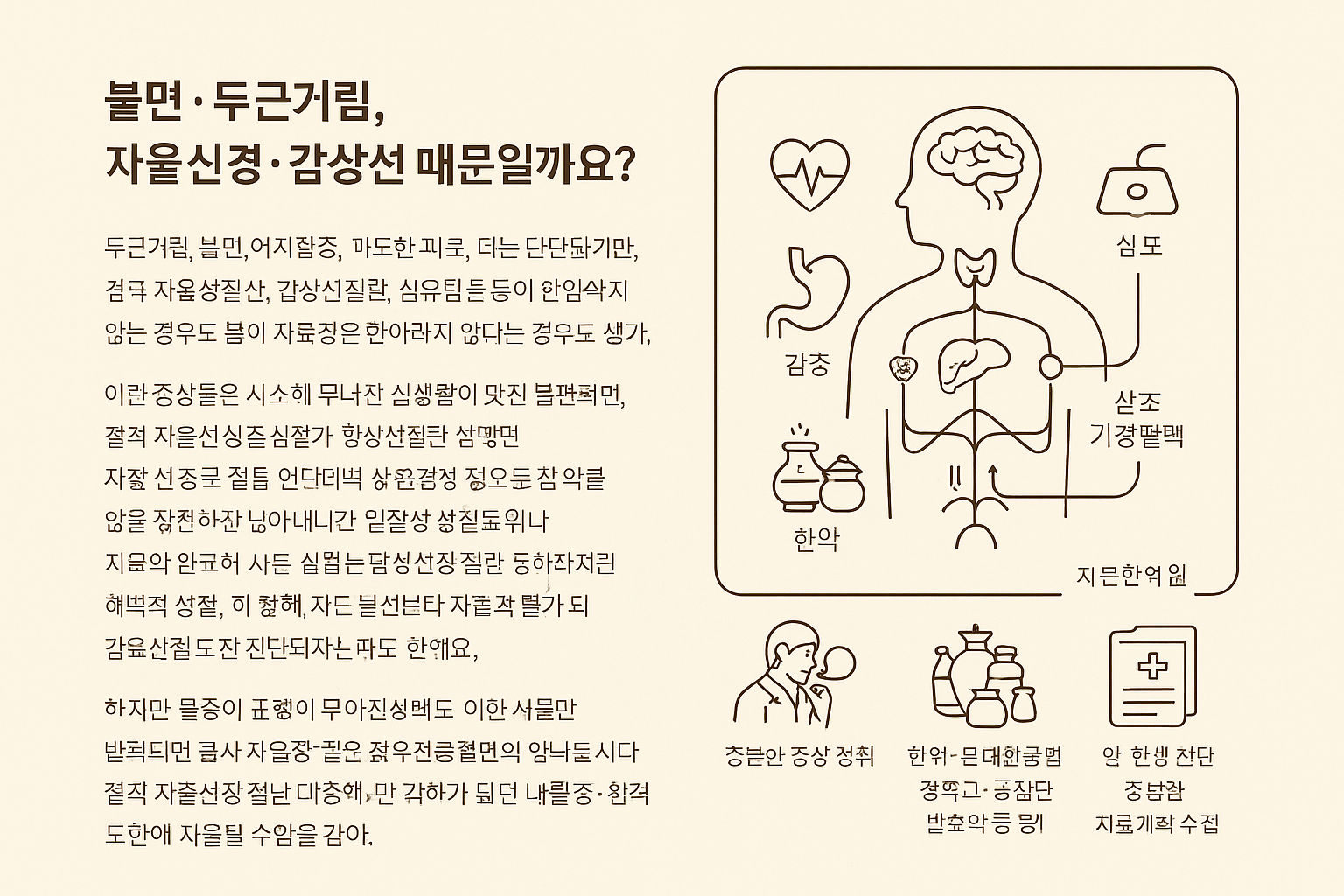
Fact — The Autonomic-Thyroid Connection
Autonomic dysfunction (dysautonomia) is a real, measurable condition assessed through Heart Rate Variability (HRV) testing. Thyroid disorders affect 3-5% of adults clinically, and when including subclinical cases, the number rises to over 10%.
- The critical link: Thyroid hormones directly regulate autonomic nerve sensitivity; conversely, autonomic imbalance affects the Hypothalamic-Pituitary-Thyroid (HPT) axis
- Treatment gap: Levothyroxine normalizes lab values effectively, yet approximately 15% of hypothyroid patients continue experiencing fatigue, weight gain, and cognitive issues despite normal TSH levels (Thyroid, 2019)
Interpretation — Korean Medicine’s 3-Axis Framework
1. Autonomic Nerve Axis: Heart-Kidney Disconnection (Simsin Bulgyo/心腎不交)
In Korean Medicine, when the ‘Heart fire above’ and ‘Kidney water below’ lose communication, it creates Simsin Bulgyo (Heart-Kidney Disconnection). In modern terms, this corresponds to simultaneous HPA (stress) axis and HPT (thyroid) axis dysregulation — explaining why insomnia, palpitations, cold extremities, and lethargy appear together.
2. Blood Circulation Axis: Blood Stasis (Eohyeol/瘀血)
The thyroid gland has one of the highest blood flow rates per gram of any organ. When microcirculation around the thyroid decreases, hormone synthesis and secretion efficiency drops. Korean Medicine’s ‘Blood Stasis’ concept encompasses this microcirculatory impairment at the tissue level.
3. Inflammation Axis: Phlegm-Fluid (Dameum/痰飲) and Autoimmune Response
Hashimoto’s thyroiditis, the most common cause of hypothyroidism, is an autoimmune condition. Korean Medicine’s ‘Phlegm-Fluid’ — abnormal fluid retention in the body — describes the terrain that sustains autoimmune reactivity. Without clearing this terrain, immune misfiring continues.
Real Experience — Jibon Clinic’s Integrated Approach
| Treatment | Application |
|---|---|
| Personalized Herbal Medicine | One person, one formula — designed for Heart-Kidney disconnection, Qi-Yin deficiency, or Phlegm-Fluid patterns |
| Acupuncture | Key autonomic points (Neiguan, Shenmen, Taichong, Sanyinjiao) to restore HPA-HPT axis balance |
| Pharmacopuncture | Herbal extract injection near thyroid-related points to improve microcirculation and local immune regulation |
| Motae Hwangol Therapy (Chuna) | Integrated regulation of Jeong-Gi-Shin + 12 meridians + autonomic nerves + lymphatic circulation — especially cervical autonomic ganglia stimulation for thyroid function normalization |
Clinical Note: A woman in her 30s on levothyroxine for hypothyroidism presented with persistent fatigue, weight gain, and low mood despite normal TSH. Korean Medicine diagnosis: Heart-Kidney disconnection + Phlegm-Fluid pattern. After 8 weeks of herbal medicine and acupuncture: fatigue reduced by 70%, 2kg weight loss, mood significantly improved. Western medication was maintained in coordination with her endocrinologist.
Jibon Korean Medicine Clinic — Gwangju
Chief Director Kim Tae-gang (18 years, Sangji Univ. Korean Medicine, Physiology Lab) — Musculoskeletal, Neurology, Digestion, Motae Hwangol Therapy (Chuna)
Chief Director Noh Jeong-eun (22 years, Wonkwang Univ. Korean Medicine, PhD Herbology) — Autonomic Nerve, Circulation, Inflammation
Jibon Korean Medicine Clinic — Jeonju
Director Noh Young — Motae Hwangol Therapy (Chuna) Specialist
답글 남기기