[카테고리:] 근골격·통증

  • Chuna Manual Therapy FAQ | Jibon Korean Medicine Clinic

    Chuna Manual Therapy FAQ | Jibon Korean Medicine Clinic

    Chuna Manual Therapy FAQ — What to Expect

    What is Motae Hwangol therapy (Chuna)?

    Chuna (추나) is a Korean Medicine manual therapy where a licensed Korean Medicine doctor uses hands and body to correct structural imbalances of the spine, pelvis, and joints. It’s similar to osteopathic manipulation but incorporates Korean Medicine diagnostic principles.

    Is Motae Hwangol therapy (Chuna) covered by insurance?

    Yes. Since 2019, Motae Hwangol therapy (Chuna) is covered by Korean National Health Insurance — up to 20 sessions per year, with approximately 50% copay. Covered conditions include herniated disc, forward head posture, scoliosis, and pelvic misalignment.

    Does Motae Hwangol therapy (Chuna) hurt?

    Most patients experience mild discomfort during treatment, not pain. You may hear popping or cracking sounds — this is normal joint cavitation. After treatment, some temporary soreness is common.

    How many sessions do I need?

    This depends on your condition. Acute issues may improve in 3–5 sessions. Chronic structural problems typically need 10–20 sessions. Your doctor will create a personalized treatment plan.

    Can foreigners receive Motae Hwangol therapy (Chuna)?

    Yes. The treatment is hands-on and doesn’t require extensive verbal communication. Basic English is available at Jibon Clinic. If you have Korean National Health Insurance, the same coverage applies.

    What conditions can Motae Hwangol therapy (Chuna) treat?

    Herniated disc (lumbar/cervical), frozen shoulder, scoliosis, pelvic asymmetry, forward head posture (text neck), TMJ disorders, post-accident musculoskeletal injuries, and more.


    Jibon Korean Medicine Clinic — Jeonju (Dr. Noh Young, Motae Hwangol & Chuna specialist) · Gwangju (Dr. Kim Tae-gang, Dr. Noh Jeong-eun)
  • Frozen Shoulder FAQ | Jibon Korean Medicine Clinic

    Frozen Shoulder FAQ | Jibon Korean Medicine Clinic

    Frozen Shoulder FAQ — Wait or Treat?

    Will frozen shoulder heal on its own?

    It often improves over 1–3 years, but many patients retain permanent range-of-motion limitations. Early treatment leads to faster, more complete recovery with less residual stiffness.

    When should I start exercising my frozen shoulder?

    Avoid forcing movement during the painful freezing phase — this can worsen inflammation. Begin gentle exercises during the frozen phase under professional guidance, then increase intensity during the thawing phase.

    Is frozen shoulder related to menopause?

    Yes. Women around menopause have higher frozen shoulder rates. Estrogen decline may accelerate joint capsule fibrosis. Treating menopause and frozen shoulder together improves outcomes.

    How does Motae Hwangol therapy (Chuna) help frozen shoulder?

    Motae Hwangol therapy (including Chuna) progressively restores joint range of motion: external rotation → abduction → forward flexion. The intensity is adjusted to the patient’s pain level. Jibon Jeonju Clinic specializes in this approach.

    How is frozen shoulder different from rotator cuff tear?

    Key difference: In frozen shoulder, both active and passive movement are restricted (even if someone else tries to move your arm). In rotator cuff tear, passive movement is usually possible. Proper clinical examination is essential for correct diagnosis.


    Jibon Korean Medicine Clinic
    Gwangju: Dr. Kim Tae-gang & Dr. Noh Jeong-eun · Jeonju: Dr. Noh Young

  • Frozen Shoulder: Should You Just Wait It Out?

    Frozen Shoulder: Should You Just Wait It Out?

    Frozen Shoulder: Should You Just Wait It Out?

    “One day I just couldn’t lift my arm anymore.”

    “I wake up every time I roll onto that side.”

    If you’re over 40 and your shoulder is gradually becoming stiffer and more painful without any injury, you may have frozen shoulder (adhesive capsulitis).

    What is Frozen Shoulder?

    The Medical Facts

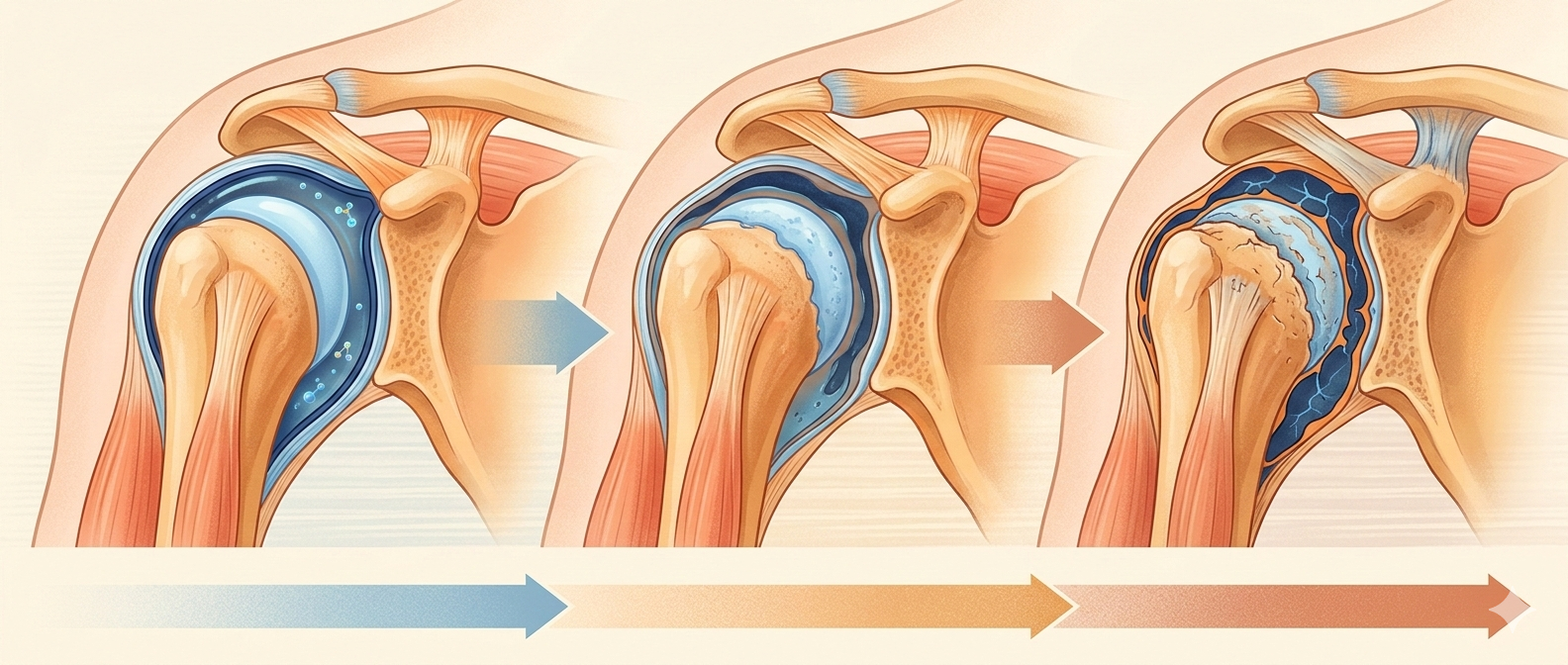
    Frozen shoulder (adhesive capsulitis) occurs when the shoulder joint capsule becomes inflamed and fibrotic, causing pain and progressive loss of motion. It typically affects people aged 45–65 and is 2–4 times more common in diabetics.

    The hallmark sign: both active AND passive movement are restricted. Even if someone else tries to move your arm, it won’t go.

    Why Does It Happen Around Age 50?

    Recent aging research (Stanford University, Nature Medicine 2019) shows that aging isn’t gradual — it occurs in bursts at specific ages, particularly around mid-40s and 60. The shoulder is the body’s most mobile joint and requires significant fluid lubrication. When age-related fluid metabolism decline hits, the shoulder is often the first to suffer.

    The Korean Medicine Perspective

    Korean Medicine calls this “Gyeon-bi” (肩痺) — stagnation of qi and blood circulation around the shoulder, leading to inadequate nourishment of the joint capsule, tendons, and ligaments. As the body’s fluid (津液/jinye) decreases with age, joint tissues lose elasticity and become prone to chronic inflammation.

    The Three Phases — And Why Timing Matters

    1. Freezing phase (painful): Inflammation is active. Focus on pain management. Acupuncture + pharmacopuncture to reduce inflammation.
    2. Frozen phase (stiff): Inflammation subsides but the joint is locked. Begin gentle Motae Hwangol therapy (including Chuna) to restore range of motion.
    3. Thawing phase (recovery): Aggressive rehabilitation, stretching, and strengthening.

    The mistake many people make: forcing movement during the freezing phase (making it worse) or doing nothing during the frozen phase (letting it stiffen further).

    Korean Medicine Treatment Approach

    • Acupuncture + Pharmacopuncture: Pain relief and local inflammation management
    • Motae Hwangol therapy (including Chuna): Progressive joint mobilization — external rotation → abduction → forward flexion. Jibon Jeonju Clinic specializes in Motae Hwangol therapy (Chuna).
    • Herbal medicine: Support circulation and address constitutional factors (especially if menopause is concurrent)

    Frequently Asked Questions

    Will frozen shoulder really heal on its own?

    It often improves over 1–3 years, but many patients retain permanent range-of-motion limitations. Early treatment leads to faster, more complete recovery.

    Is frozen shoulder related to menopause?

    Yes. Women around menopause have higher rates of frozen shoulder. Estrogen decline may accelerate joint capsule fibrosis. Treating both conditions together improves outcomes.

    Can I get Motae Hwangol therapy (Chuna) for frozen shoulder in Jeonju?

    Yes. Jibon Jeonju Clinic (Dr. Noh Young) specializes in Motae Hwangol therapy (including Chuna) for frozen shoulder and other musculoskeletal conditions.


    Jibon Korean Medicine Clinic

    Gwangju: Dr. Kim Tae-gang (Musculoskeletal/Motae Hwangol, 18 yrs) & Dr. Noh Jeong-eun (Autonomic/Circulation, 22 yrs, Ph.D.)
    Jeonju: Dr. Noh Young (Motae Hwangol specialist)

  • 추나요법 FAQ: 체형교정부터 보험 적용까지

    추나요법 FAQ: 체형교정부터 보험 적용까지

    추나요법 FAQ: 체형교정부터 보험 적용까지

    “추나가 정확히 뭔가요? 카이로프랙틱이랑 다른 건가요?” 추나요법에 대해 가장 많이 받는 질문을 정리했습니다.

    자주 묻는 질문

    추나요법은 어떤 치료인가요?

    추나요법은 한의사가 손 또는 신체 일부, 보조 기구를 사용하여 환자의 신체 구조(척추, 골반, 관절 등)에 유효한 자극을 가해 구조적·기능적 불균형을 바로잡는 한의학 수기치료법입니다. 2019년부터 건강보험이 적용되어 보다 합리적인 비용으로 치료받을 수 있습니다.

    추나요법과 카이로프랙틱은 어떻게 다른가요?

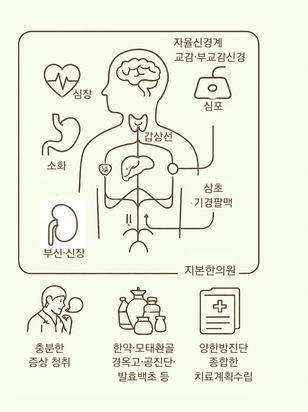
    추나요법은 한의학 이론(경락, 기혈)에 기반하며, 침·한약 등 한의학적 치료와 통합적으로 시행됩니다. 카이로프랙틱은 주로 관절 교정에 집중합니다. 추나요법은 근골격계 구조 교정뿐 아니라 내과적 문제(소화기, 자율신경 등)까지 고려하는 통합적 접근이 특징입니다.

    추나요법은 건강보험이 적용되나요?

    네. 2019년 4월부터 추나요법에 건강보험이 적용됩니다. 연간 20회까지 보험 적용이 가능하며, 본인 부담률은 약 50% 수준입니다. 적응증(허리 디스크, 거북목, 척추 측만 등)에 해당하면 보험 적용 치료를 받을 수 있습니다.

    어떤 증상에 추나요법이 도움이 되나요?

    허리 통증, 목 통증, 거북목, 척추 측만, 골반 틀어짐, 체형 불균형, 오십견, 어깨 통증, 두통, 턱관절 장애 등 근골격계 문제에 널리 적용됩니다. 전주 지본한의원은 모태환골법(추나요법) 전문으로 체형교정·골격교정에 특화되어 있습니다.

    추나요법은 아프지 않나요?

    시술 방법에 따라 다르지만, 대부분의 추나요법은 통증이 크지 않습니다. 시술 후 일시적으로 뻐근함이 느껴질 수 있으나, 이는 근육과 관절이 재정렬되는 과정에서 나타나는 자연스러운 반응입니다. 한의사가 환자 상태에 맞춰 강도를 조절합니다.


    글쓴이: 노정은 원장 | 광주 봉선동 지본한의원

    20년 경력 한의사. 자율신경·혈류·염증 기반 회복단계 관리 전문.

    지본한의원 광주점

    • 위치: 광주광역시 남구 봉선동
    • 진료: 추나요법, 한약 처방, 돌발성 난청·갱년기·만성통증 특화

    지본한의원 전주점

    • 위치: 전주시
    • 진료: 모태환골법(추나요법) 전문, 체형교정, 골격교정
  • 오십견(동결견) FAQ: 기다려야 할까, 치료해야 할까

    오십견(동결견) FAQ: 기다려야 할까, 치료해야 할까

    오십견(동결견) FAQ: 기다려야 할까, 치료해야 할까

    “팔이 안 올라가서 머리도 못 감겠어요.” 오십견은 40~60대에 흔하지만, 단순히 기다리는 것만이 답은 아닙니다.

    자주 묻는 질문

    오십견은 정확히 어떤 질환인가요?

    오십견은 유착성 관절낭염(동결견, frozen shoulder)으로, 어깨 관절을 감싸는 관절낭에 염증과 섬유화가 진행되면서 통증과 운동 제한이 나타나는 질환입니다. 특별한 외상 없이 발생하는 경우가 많으며, 40대 후반~60대에 집중됩니다.

    오십견은 그냥 기다리면 낫나요?

    시간이 지나면 호전되는 경우가 많지만, 최근 통계에 따르면 상당수에서 기능 제한이 남습니다. 초기 염증 관리와 단계별 운동 병행이 회복을 빠르게 하고 후유증을 줄입니다. “사용하지 않으면 더 굳는다”는 말이 오십견에서는 특히 맞지만, 염증이 심한 시기에 무리한 운동은 오히려 해가 됩니다.

    오십견과 회전근개 파열은 어떻게 구별하나요?

    오십견은 능동적·수동적 움직임 모두 제한되는 것이 특징입니다. 다른 사람이 팔을 들어줘도 움직이지 않습니다. 반면 회전근개 파열은 수동적으로는 움직일 수 있는 경우가 많습니다. 석회성 건염, 경추 디스크도 감별이 필요하므로 전문가 진단을 받으시기 바랍니다.

    오십견에 추나요법이 도움이 되나요?

    추나요법은 굳어진 관절의 가동범위를 점진적으로 회복시키는 데 도움이 될 수 있습니다. 침·약침으로 초기 통증을 줄이고, 한약으로 기혈 순환과 염증 체질을 개선하며, 추나요법으로 관절 기능을 회복하는 복합적 접근이 가능합니다. 전주 지본한의원은 모태환골법(추나요법)에 특화되어 있습니다.

    오십견의 단계별 치료 접근은?

    오십견은 일반적으로 외회전(팔을 뒤로 돌리기) → 외전(옆으로 들기) → 전방굴곡(앞으로 올리기) 순서로 굳어지고, 회복은 그 반대 순서입니다. 초기 통증기에는 염증 억제와 통증 관리가 우선이고, 동결기에는 점진적 관절 운동, 해동기에는 적극적 재활이 필요합니다.


    글쓴이: 노정은 원장 | 광주 봉선동 지본한의원

    20년 경력 한의사. 자율신경·혈류·염증 기반 회복단계 관리 전문.

    지본한의원 광주점

    • 위치: 광주광역시 남구 봉선동
    • 진료: 추나요법, 한약 처방, 돌발성 난청·갱년기·만성통증 특화

    지본한의원 전주점

    • 위치: 전주시
    • 진료: 모태환골법(추나요법) 전문, 체형교정, 골격교정
  • 오십견, 그냥 기다려도 될까? 단계별 접근법

    오십견, 그냥 기다려도 될까? 단계별 접근법

    오십견, 그냥 기다려도 될까? 단계별 접근법 | 광주 지본한의원

    “어느 날 갑자기 팔이 안 올라가요.”

    “밤에 아픈 쪽으로 돌아누우면 잠을 깨요.”

    “브래지어 뒤 고리를 못 채우겠어요.”

    40대 이상에서 특별히 다친 적도 없는데 어깨가 굳어간다면, 오십견을 의심해볼 수 있습니다.


    오십견이란: 50세 전후의 어깨 변화

    팩트(Fact)

    오십견(五十肩)은 의학적으로 유착성 관절낭염(adhesive capsulitis) 또는 동결견(frozen shoulder)이라 합니다. 어깨 관절을 감싸는 관절낭에 염증과 섬유화가 진행되면서 통증과 운동 제한이 나타납니다. 40대 후반~60대에 호발하며, 당뇨 환자에서 발생률이 2~4배 높습니다.

    해석(Interpretation) — 한의학적 관점

    한의학에서는 오십견을 견비(肩痺)라 하며, 기혈 순환의 정체로 인해 근육·인대·관절낭에 영양 공급이 부족해진 상태로 봅니다. 노화에 따라 진액(津液)이 줄고 수분 유지 능력이 떨어지면, 관절 주변 조직에 점성이 생기고 만성 염증으로 이어집니다.

    실제 경험(Real Experience) — 지본한의원 임상

    지본한의원에서는 오십견 환자 대부분이 “어느 순간 갑자기 굳었다”고 표현합니다. 하지만 실제로는 수개월에 걸쳐 서서히 진행된 것을 한 시점에서 자각하는 경우가 많습니다.


    노화의 분절점: 왜 하필 50세인가

    팩트(Fact)

    최근 노화 연구에 따르면, 노화는 서서히가 아닌 특정 시점에 분절적으로 진행됩니다. 40대 중반과 60세 전후에 급격한 분자적 변화가 관찰되었습니다(Stanford University, Nature Medicine 2019).

    해석(Interpretation)

    어깨는 인체에서 가동 범위가 가장 넓은 관절입니다. 넓은 움직임을 지탱하기 위해 수분을 많이 사용하는 부위이므로, 노화에 따른 수분 대사 저하의 영향을 가장 먼저 받습니다. 마치 에센스가 부족한 피부처럼 수분이 겔화되듯 점성이 생기고, 이것이 만성적 염증으로 이어집니다.


    그냥 기다리면 안 되는 이유

    팩트(Fact)

    오십견은 1~3년에 걸쳐 자연 호전되는 경우가 많지만, 최근 통계에 따르면 상당수에서 기능 제한이 남습니다. 운동 범위가 완전히 회복되지 않거나, 반대쪽 어깨에도 발생할 수 있습니다.

    실제 경험(Real Experience)

    “사용하지 않으면 더 굳는다”는 말이 오십견에서는 특히 맞습니다. 그러나 염증이 심한 시기에 무리한 운동은 오히려 해가 됩니다. 단계에 맞춘 접근이 핵심입니다:

    1. 통증기 (초기): 염증 억제, 통증 관리 우선. 침·약침으로 통증 완화

    2. 동결기 (중기): 점진적 관절 운동 시작. 추나요법으로 가동범위 회복

    3. 해동기 (후기): 적극적 재활, 스트레칭 강화


    감별진단: 모든 어깨 통증이 오십견은 아니다

    팩트(Fact)

    어깨 통증의 원인은 다양합니다:

    • 회전근개 파열: 수동적 움직임은 가능 (오십견은 수동적으로도 제한)
    • 석회성 건염: 급성 극심 통증, X-ray로 확인
    • 경추 디스크: 목에서 팔로 방사되는 통증

    감별 포인트

    오십견의 핵심 소견은 능동적 움직임과 수동적 움직임 모두가 제한된다는 것입니다. 다른 사람이 팔을 들어줘도 움직이지 않습니다.

    실제 경험(Real Experience)

    지본한의원에서는 초진 시 회전근개 검사, 경추 관련 신경학적 검사를 함께 시행하여 정확한 감별 후 치료 계획을 세웁니다.


    오십견에 대한 한방치료 접근

    침·약침 치료

    초기 통증을 줄여 운동을 더 수월하게 할 수 있도록 돕습니다. 어깨 주변 경혈과 아시혈에 침 치료를 시행하고, 약침으로 국소 염증을 관리합니다.

    추나요법

    굳어진 관절의 가동범위를 점진적으로 회복시킵니다. 외회전 → 외전 → 전방굴곡 순서로 회복시키며, 환자의 통증 수준에 맞춰 강도를 조절합니다. 전주 지본한의원은 모태환골법(추나요법)에 특화되어 있습니다.

    한약 처방

    기혈 순환을 돕고 염증 체질을 개선합니다. 갱년기가 동반된 경우 수분 대사 조절 한약을 병행합니다.


    자주 묻는 질문

    오십견은 정말 저절로 낫나요?

    시간이 지나면 호전되는 경우가 많지만, 기능 제한이 남을 수 있습니다. 초기부터 적절한 치료를 받으면 회복이 빠르고 후유증이 줄어듭니다.

    오십견 운동은 언제부터 하면 되나요?

    통증이 심한 초기에는 무리한 운동을 자제하고, 동결기 이후 전문가 지도 하에 점진적으로 시작하는 것이 안전합니다.

    오십견과 갱년기가 관련이 있나요?

    네. 폐경 전후 여성에서 오십견 발생률이 높습니다. 에스트로겐 감소가 관절낭 섬유화를 촉진할 수 있어, 갱년기 체질 관리를 함께 하면 도움이 됩니다.

    전주에서 추나요법으로 오십견 치료를 받을 수 있나요?

    전주 지본한의원에서 모태환골법(추나요법) 전문 치료를 제공합니다. 체형교정, 골격교정과 함께 오십견의 관절 가동범위 회복에 특화되어 있습니다.


    글쓴이: 노정은 원장 | 광주 봉선동 지본한의원

    20년 경력 한의사. 자율신경·혈류·염증 기반 회복단계 관리 전문.

    지본한의원 광주점

    • 위치: 광주광역시 남구 봉선동
    • 진료: 추나요법, 한약 처방, 돌발성 난청·갱년기·만성통증 특화

    지본한의원 전주점

    • 위치: 전주시
    • 진료: 모태환골법(추나요법) 전문, 체형교정, 골격교정