[카테고리:] 면역·장·감염

  • 황반변성 자주 묻는 질문 (FAQ)

    황반변성 자주 묻는 질문 (FAQ)

    황반변성 자주 묻는 질문

    황반변성에 한의원 치료가 가능한가요?

    네. 한약, 침, 모태환골법(추나요법) 등으로 증상 완화와 근본 원인 개선 모두에 접근합니다.

    양약과 한약을 같이 먹어도 되나요?

    네. 2시간 이상 간격을 두고 복용하면 안전하게 병행할 수 있습니다. 복용 중인 약은 진료 시 알려주세요.

    치료 기간은 얼마나 걸리나요?

    급성 증상은 2~4주 내 호전, 만성·재발성은 3~6개월 체질 개선이 필요합니다. 개인차가 있습니다.

    보험 적용이 되나요?

    침·뜸·부항은 건강보험 적용, 모태환골법(추나요법) 연 20회 보험 적용. 한약은 비급여입니다.

    어떤 원장님이 진료하시나요?

    증상에 따라 김태강 대표원장(근골격·신경계·소화) 또는 노정은 대표원장(자율신경·혈류·염증)이 진료합니다. 전주는 노영 원장이 진료합니다.


    지본한의원

    광주 봉선동: 대표원장 김태강 (근골격·신경계·소화·모태환골법) · 대표원장 노정은 (자율신경·혈류·염증, 한의학박사)
    전주: 원장 노영 (모태환골법 전문)

  • 황반변성, 눈의 노화를 늦추는 한의학적 관리

    황반변성, 눈의 노화를 늦추는 한의학적 관리

    황반변성이란?

    황반변성은 현대인에게 흔한 만성 질환으로, 단순한 증상 치료만으로는 근본적 해결이 어렵습니다. 스트레스, 면역 불균형, 생활습관이 복합적으로 작용합니다.

    의학적 사실

    서양의학에서는 주로 약물(항히스타민제, 스테로이드, 면역억제제 등)로 증상을 관리합니다. 그러나 약물 중단 시 재발하는 경우가 많고, 장기 복용 시 부작용 우려가 있습니다.

    한의학적 해석

    지본한의원에서는 자율신경·혈류·염증 3축 관점에서 접근합니다:

    • 자율신경 불균형: 면역 반응의 과잉 또는 저하를 조절하는 핵심 축
    • 혈류 순환: 국소 부위의 혈류 개선이 조직 회복의 기반
    • 만성 염증: 체내 축적된 염증 반응을 한약과 침으로 조절

    모태환골법(추나요법)으로 경락과 림프 순환을 통합 조절하고, 체질 맞춤 한약으로 근본 원인에 접근합니다.

    지본한의원의 치료 경험

    오랜 임상 경험을 통해 황반변성 환자분들의 다양한 패턴을 파악하고 있습니다. 급성기 증상 완화와 장기적 체질 개선을 병행하여, 재발 빈도를 줄이고 삶의 질을 높이는 것이 목표입니다.

    자주 묻는 질문

    황반변성에 한방치료가 효과적인가요?

    네. 한약, 침, 모태환골법(추나요법) 등을 통해 증상 완화와 체질 개선 모두에 접근합니다. 양약과 병행 가능합니다.

    치료 기간은 얼마나 걸리나요?

    급성기는 2~4주 내 호전되는 경우가 많고, 만성 재발성인 경우 3~6개월 이상 체질 개선이 필요합니다.


    지본한의원

    광주 봉선동: 대표원장 김태강 (근골격·신경계·소화·모태환골법) · 대표원장 노정은 (자율신경·혈류·염증, 한의학박사)
    전주: 원장 노영 (모태환골법 전문)

  • Rhinitis & Asthma FAQ | Jibon Korean Medicine Clinic

    Rhinitis & Asthma FAQ | Jibon Korean Medicine Clinic

    Rhinitis & Asthma FAQ

    Can Korean Medicine treat Rhinitis & Asthma?

    Yes. Herbal medicine, acupuncture, and Motae Hwangol therapy address both symptom relief and root cause improvement.

    Can I take Korean Medicine with Western medications?

    Yes. Maintain a 2-hour gap between medications. Inform your doctor of all current medications during consultation.

    How long does treatment take?

    Acute: 2-4 weeks improvement. Chronic/recurring: 3-6 months constitutional treatment. Individual results vary.

    Is treatment covered by insurance?

    Acupuncture, moxibustion are covered by Korean NHI. Motae Hwangol (Chuna) therapy: 20 sessions/year covered. Herbal medicine: self-pay.

    Which doctor will I see?

    Gwangju: Dr. Kim Tae-gang (musculoskeletal/neuro/digestive) or Dr. Noh Jeong-eun (autonomic/circulation/inflammation). Jeonju: Dr. Noh Young.


    Jibon Korean Medicine Clinic
    Gwangju: Dr. Kim Tae-gang & Dr. Noh Jeong-eun · Jeonju: Dr. Noh Young

  • Rhinitis & Asthma: Managing Immune Overreaction with Korean Medicine

    Rhinitis & Asthma: Managing Immune Overreaction with Korean Medicine

    What is Rhinitis & Asthma?

    Rhinitis & Asthma is a common chronic condition that often resists simple symptomatic treatment. Stress, immune imbalance, and lifestyle factors all play interconnected roles.

    Western Medical Approach

    Standard treatment typically involves medications (antihistamines, steroids, immunosuppressants). While effective for symptom control, these often lead to recurrence upon discontinuation and carry risks of long-term side effects.

    The Korean Medicine Perspective

    At Jibon Clinic, we approach Rhinitis & Asthma through three axes:

    • Autonomic balance: The core regulator of immune overreaction or suppression
    • Circulation: Local blood flow improvement as foundation for tissue recovery
    • Chronic inflammation: Herbal medicine and acupuncture to modulate accumulated inflammatory responses

    Motae Hwangol therapy (Chuna) integrates meridian and lymphatic regulation. Personalized herbal prescriptions address root causes.

    Treatment at Jibon Clinic

    With extensive clinical experience in treating Rhinitis & Asthma, we combine acute symptom relief with long-term constitutional improvement to reduce recurrence and improve quality of life.

    FAQ

    Can Korean Medicine effectively treat Rhinitis & Asthma?

    Yes. Through herbal medicine, acupuncture, and Motae Hwangol therapy, we address both symptoms and underlying constitution. Safe to combine with Western medications.

    How long does treatment take?

    Acute symptoms often improve within 2-4 weeks. Chronic or recurring conditions may need 3-6 months of constitutional treatment.


    Jibon Korean Medicine Clinic
    Gwangju: Dr. Kim Tae-gang & Dr. Noh Jeong-eun · Jeonju: Dr. Noh Young

  • 비염·천식 자주 묻는 질문 (FAQ)

    비염·천식 자주 묻는 질문 (FAQ)

    비염·천식 자주 묻는 질문

    비염·천식에 한의원 치료가 가능한가요?

    네. 한약, 침, 모태환골법(추나요법) 등으로 증상 완화와 근본 원인 개선 모두에 접근합니다.

    양약과 한약을 같이 먹어도 되나요?

    네. 2시간 이상 간격을 두고 복용하면 안전하게 병행할 수 있습니다. 복용 중인 약은 진료 시 알려주세요.

    치료 기간은 얼마나 걸리나요?

    급성 증상은 2~4주 내 호전, 만성·재발성은 3~6개월 체질 개선이 필요합니다. 개인차가 있습니다.

    보험 적용이 되나요?

    침·뜸·부항은 건강보험 적용, 모태환골법(추나요법) 연 20회 보험 적용. 한약은 비급여입니다.

    어떤 원장님이 진료하시나요?

    증상에 따라 김태강 대표원장(근골격·신경계·소화) 또는 노정은 대표원장(자율신경·혈류·염증)이 진료합니다. 전주는 노영 원장이 진료합니다.


    지본한의원

    광주 봉선동: 대표원장 김태강 (근골격·신경계·소화·모태환골법) · 대표원장 노정은 (자율신경·혈류·염증, 한의학박사)
    전주: 원장 노영 (모태환골법 전문)

  • 비염·천식, 면역의 과잉 반응을 다스리는 한의학적 접근

    비염·천식, 면역의 과잉 반응을 다스리는 한의학적 접근

    비염·천식이란?

    비염·천식은 현대인에게 흔한 만성 질환으로, 단순한 증상 치료만으로는 근본적 해결이 어렵습니다. 스트레스, 면역 불균형, 생활습관이 복합적으로 작용합니다.

    의학적 사실

    서양의학에서는 주로 약물(항히스타민제, 스테로이드, 면역억제제 등)로 증상을 관리합니다. 그러나 약물 중단 시 재발하는 경우가 많고, 장기 복용 시 부작용 우려가 있습니다.

    한의학적 해석

    지본한의원에서는 자율신경·혈류·염증 3축 관점에서 접근합니다:

    • 자율신경 불균형: 면역 반응의 과잉 또는 저하를 조절하는 핵심 축
    • 혈류 순환: 국소 부위의 혈류 개선이 조직 회복의 기반
    • 만성 염증: 체내 축적된 염증 반응을 한약과 침으로 조절

    모태환골법(추나요법)으로 경락과 림프 순환을 통합 조절하고, 체질 맞춤 한약으로 근본 원인에 접근합니다.

    지본한의원의 치료 경험

    오랜 임상 경험을 통해 비염·천식 환자분들의 다양한 패턴을 파악하고 있습니다. 급성기 증상 완화와 장기적 체질 개선을 병행하여, 재발 빈도를 줄이고 삶의 질을 높이는 것이 목표입니다.

    자주 묻는 질문

    비염·천식에 한방치료가 효과적인가요?

    네. 한약, 침, 모태환골법(추나요법) 등을 통해 증상 완화와 체질 개선 모두에 접근합니다. 양약과 병행 가능합니다.

    치료 기간은 얼마나 걸리나요?

    급성기는 2~4주 내 호전되는 경우가 많고, 만성 재발성인 경우 3~6개월 이상 체질 개선이 필요합니다.


    지본한의원

    광주 봉선동: 대표원장 김태강 (근골격·신경계·소화·모태환골법) · 대표원장 노정은 (자율신경·혈류·염증, 한의학박사)
    전주: 원장 노영 (모태환골법 전문)

  • Indigestion & Stomach Problems FAQ — Korean Medicine Treatment Guide

    Indigestion & Stomach Problems FAQ — Korean Medicine Treatment Guide

    Frequently Asked Questions: Indigestion & Korean Medicine

    Q1. Can Korean Medicine really treat digestive problems? Shouldn’t I see a gastroenterologist first?

    If you have already had an endoscopy or basic tests ruling out structural issues (ulcers, tumors, H. pylori), Korean Medicine is highly effective for functional digestive disorders. In fact, when standard medications like PPIs provide only temporary relief, Korean Medicine’s whole-body approach often delivers lasting improvement by addressing the underlying autonomic and circulatory imbalance.

    Q2. Will herbal medicine upset my stomach further?

    At Jibon Clinic, every herbal prescription follows the principle of “one person, one formula.” For patients with weak digestion, we start with gentle, stomach-friendly formulas. The herbs themselves are designed to restore digestive function, not burden it.

    Q3. How long does treatment typically take?

    Acute indigestion often improves within 1-2 weeks. Chronic functional dyspepsia (6+ months) typically requires 4-8 weeks of focused treatment before transitioning to a maintenance phase. Your treatment plan will be personalized after a thorough initial assessment.

    Q4. Can acid reflux (GERD) be treated with Korean Medicine?

    Yes. Acid reflux is often not just about excess acid — it involves lower esophageal sphincter dysfunction and autonomic imbalance. Acupuncture helps restore sphincter tone, while herbal medicine normalizes the entire GI motility rhythm.

    Q5. I have indigestion along with fatigue and insomnia. Can everything be treated together?

    This is exactly where Korean Medicine excels. Indigestion, fatigue, and insomnia often share the same root: autonomic nervous system dysregulation. At Jibon Clinic, we treat the whole system rather than individual symptoms, which is why multiple complaints often improve simultaneously.


    Jibon Korean Medicine Clinic — Gwangju
    Chief Director Kim Tae-gang (18 years, Sangji Univ. Korean Medicine, Physiology Lab) — Musculoskeletal, Neurology, Digestion, Motae Hwangol Therapy (Chuna)
    Chief Director Noh Jeong-eun (22 years, Wonkwang Univ. Korean Medicine, PhD Herbology) — Autonomic Nerve, Circulation, Inflammation

    Jibon Korean Medicine Clinic — Jeonju
    Director Noh Young — Motae Hwangol Therapy (Chuna) Specialist

  • Chronic Indigestion & Stomach Problems — How Korean Medicine Treats the Root Cause

    Chronic Indigestion & Stomach Problems — How Korean Medicine Treats the Root Cause

    Fact — How Common Is Functional Dyspepsia?

    Functional dyspepsia affects approximately 20-30% of the global adult population. According to research published in Gut (2020), the neuro-immune interaction disorder within the gastrointestinal tract has been identified as the key mechanism behind this condition.

    • Standard treatments: Proton pump inhibitors (PPIs) and prokinetic agents are first-line options, but long-term use carries risks of nutrient malabsorption and rebound acid secretion
    • Key insight: Over 60% of patients with chronic indigestion show no structural abnormalities on endoscopy — it is a functional disorder

    Interpretation — The Korean Medicine 3-Axis Approach

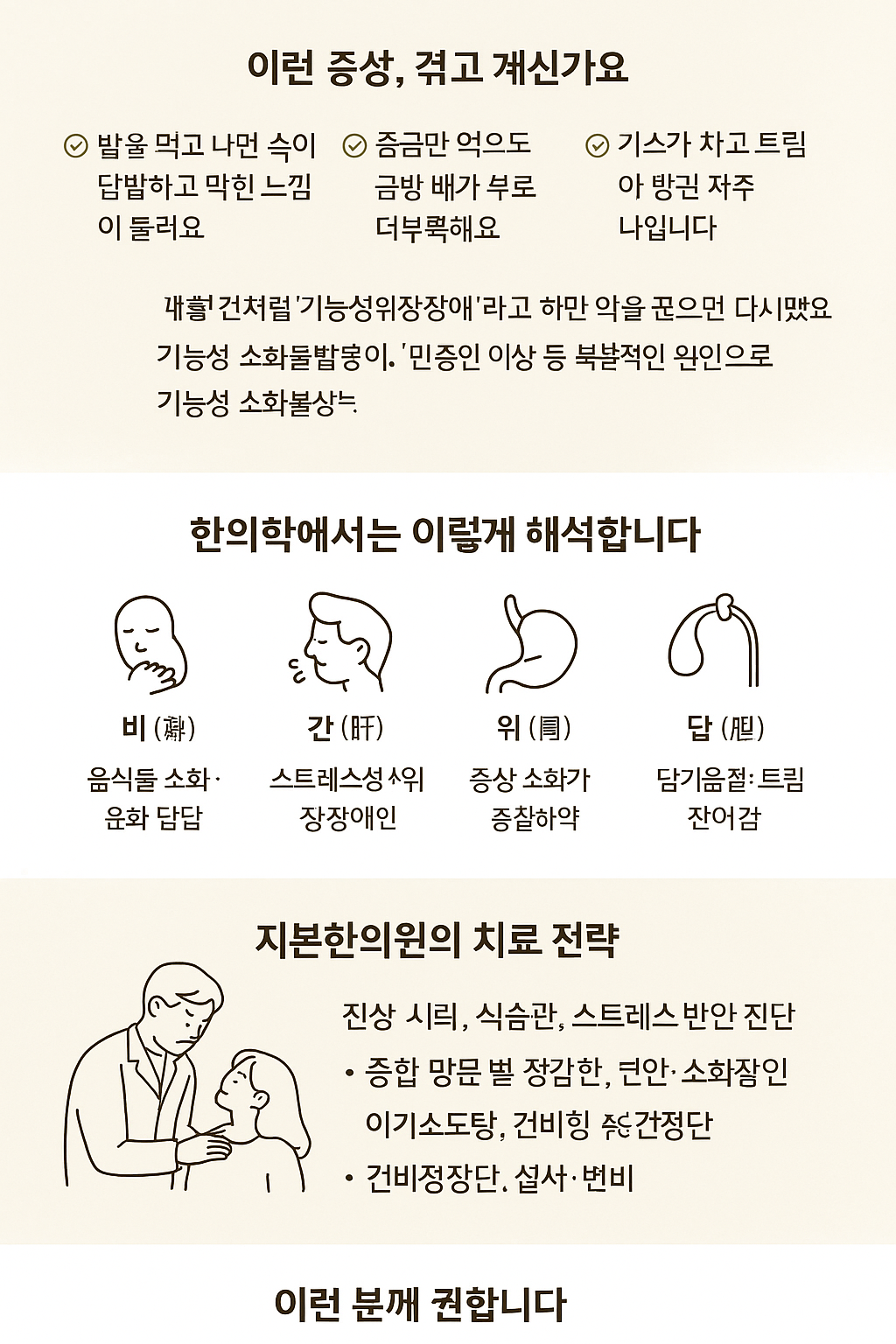
    Korean Medicine (Hanbang/한방) views digestion as part of a whole-body system, not an isolated stomach issue. At Jibon Korean Medicine Clinic, we analyze digestive problems through three interconnected axes:

    1. Autonomic Nerve Axis

    In Korean Medicine, the Spleen (Pi/脾) and Stomach (Wi/胃) maintain an ascending-descending rhythm that directly corresponds to the sympathetic-parasympathetic balance. Chronic stress disrupts this rhythm, leading to gastroparesis-like symptoms without structural damage.

    2. Blood Circulation Axis

    Many patients with chronic indigestion also experience cold extremities and abdominal coldness. Korean Medicine identifies this as ‘Spleen-Stomach Cold Deficiency’ (Biwi Heohan/脾胃虛寒) — reduced microcirculation to the GI tract impairs enzyme secretion and peristalsis.

    3. Inflammation Axis

    Recurrent bloating and heartburn often indicate low-grade chronic inflammation of the gastric mucosa. The Korean Medicine concept of ‘Damp-Heat’ (Seupyeol/濕熱) aligns with modern understanding of gut microbiome imbalance and mucosal inflammation.

    Real Experience — How Jibon Clinic Treats Digestive Disorders

    Treatment How It Works
    Personalized Herbal Medicine One person, one prescription — each formula is tailored to your constitution and current digestive state
    Acupuncture Stimulating key points (Zusanli, Zhongwan, Neiguan) to restore autonomic balance and GI motility
    Pharmacopuncture Herbal extracts injected at acupoints to enhance microcirculation in the digestive system
    Motae Hwangol Therapy (Chuna) Integrated regulation of Jeong-Gi-Shin + 12 meridians + autonomic nerves + lymphatic circulation to relieve abdominal tension and normalize gut movement

    Clinical Note: A female patient in her 40s presented with upper abdominal bloating alongside neck/shoulder stiffness and insomnia. Rather than targeting the stomach alone, we regulated her entire autonomic nervous system. Within 4 weeks, her digestion normalized and sleep quality improved simultaneously.


    Jibon Korean Medicine Clinic — Gwangju
    Chief Director Kim Tae-gang (18 years experience, Sangji University Korean Medicine, Physiology Lab Researcher) — Musculoskeletal, Nervous System, Digestive Disorders, Motae Hwangol Therapy (Chuna)
    Chief Director Noh Jeong-eun (22 years experience, Wonkwang University Korean Medicine, PhD in Herbology) — Autonomic Nerve, Circulation, Inflammation

    Jibon Korean Medicine Clinic — Jeonju
    Director Noh Young — Motae Hwangol Therapy (Chuna) Specialist

  • 소화불량·위장장애 자주 묻는 질문 (FAQ) — 한의원 치료 궁금증 해결

    소화불량·위장장애 자주 묻는 질문 (FAQ) — 한의원 치료 궁금증 해결

    소화불량·위장장애 FAQ

    Q1. 소화불량인데 한의원에 가도 되나요? 내과가 먼저 아닌가요?

    위내시경 등 기본 검사에서 기질적 문제가 없다면, 한의원 치료가 매우 효과적입니다. 기능성 소화불량은 자율신경·혈류·소화관 운동의 기능적 문제이기 때문에 한의학의 전신 조절 접근이 강점입니다. 물론 검사를 먼저 받고 오시는 것도 좋고, 지본한의원에서는 필요 시 양방 검사를 권유해 드립니다.

    Q2. 한약을 먹으면 소화가 더 안 되지 않나요?

    오히려 반대입니다. 지본한의원의 한약은 한 사람 한 처방으로 체질과 현재 위장 상태에 맞춰 구성합니다. 소화력이 약한 분에게는 위장 부담이 적은 처방부터 시작하며, 한약 자체가 소화 기능을 회복시키는 치료제 역할을 합니다.

    Q3. 치료 기간은 보통 얼마나 걸리나요?

    급성 소화불량은 1~2주 내 증상 개선을 느끼는 경우가 많습니다. 만성 기능성 소화불량(6개월 이상)은 4~8주 정도의 집중 치료 후 유지 관리 단계로 넘어갑니다. 단, 개인차가 있으므로 초진 시 상태를 정확히 평가한 후 치료 계획을 안내해 드립니다.

    Q4. 역류성 식도염도 한의원에서 치료할 수 있나요?

    네, 가능합니다. 역류성 식도염은 위산 과다만의 문제가 아니라 하부식도괄약근의 기능 저하와 자율신경 불균형이 근본 원인인 경우가 많습니다. 침 치료로 괄약근 기능을 회복시키고, 한약으로 위장관 전체의 운동 리듬을 정상화하는 치료를 진행합니다.

    Q5. 소화불량과 함께 피로·불면이 있는데 같이 치료되나요?

    그것이 바로 한의학 치료의 핵심 장점입니다. 소화불량, 피로, 불면은 모두 자율신경 실조라는 같은 뿌리에서 나온 가지입니다. 지본한의원에서는 증상별로 따로 치료하지 않고, 전신의 자율신경·혈류·염증 균형을 동시에 조절하여 여러 증상이 함께 개선되는 경우가 많습니다.

    Q6. 모태환골법(추나요법)이 소화불량에도 도움이 되나요?

    모태환골법(추나요법)은 정·기·신 + 12경락 + 자율신경 + 림프 순환을 통합적으로 조절하는 치료법입니다. 특히 흉추·요추 주변의 자율신경절 자극을 통해 위장관 운동을 직접적으로 활성화할 수 있습니다. 등이 뻣뻣하고 소화가 안 되는 분들에게 특히 효과적입니다.


    광주 지본한의원
    대표원장 김태강 (18년 경력, 상지대 한의과대학, 생리학교실 연구원) — 근골격·신경계·소화·모태환골법(추나요법) 전문
    대표원장 노정은 (22년 경력, 원광대 한의과대학, 한의학박사 본초학) — 자율신경·혈류·염증 전문

    전주 지본한의원
    원장 노영 — 모태환골법(추나요법) 전문

  • 소화불량·위장장애, 왜 반복될까? — 한의학이 보는 근본 원인과 치료

    소화불량·위장장애, 왜 반복될까? — 한의학이 보는 근본 원인과 치료

    Fact — 소화불량, 얼마나 흔한가

    기능성 소화불량(Functional Dyspepsia)은 성인 인구의 약 20~30%가 경험하는 가장 흔한 소화기 질환 중 하나입니다. 대한소화기학회에 따르면 위내시경에서 특별한 기질적 원인이 발견되지 않는 경우가 전체 소화불량 환자의 약 60% 이상을 차지합니다.

    • 유병률: 한국 성인 약 25%, 여성이 남성보다 1.5배 높음
    • 표준 치료: 양성자펌프억제제(PPI), 위장운동촉진제가 1차 선택이나, 장기 복용 시 영양소 흡수 저하·리바운드 산분비 등 부작용 보고
    • 학술 근거: Gut(2020) 연구에서 기능성 소화불량 환자의 위장관 신경-면역 상호작용 이상이 핵심 기전으로 확인됨

    Interpretation — 한의학의 3축 해석

    1. 자율신경축: 비위(脾胃)의 승강(昇降) 실조

    한의학에서 소화는 단순히 위장의 문제가 아닙니다. 비(脾)는 올리고, 위(胃)는 내리는 — 이 승강 운동이 자율신경의 교감·부교감 균형과 정확히 대응합니다. 스트레스, 과로, 수면 부족으로 자율신경 균형이 무너지면 위장의 운동력 자체가 저하됩니다.

    2. 혈류축: 위장관 미세순환 저하

    만성적인 소화불량 환자의 상당수에서 복부 냉감, 사지 말단 냉증이 동반됩니다. 한의학에서는 이를 ‘비위허한(脾胃虛寒)’으로 진단하며, 위장관으로의 혈류 공급 부족이 소화 효소 분비 저하와 연동 운동 약화의 원인이 됩니다.

    3. 염증축: 습열(濕熱)과 저등급 만성 염증

    속쓰림, 더부룩함이 반복되는 분들 중 상당수가 위점막의 저등급 만성 염증(low-grade chronic inflammation) 상태입니다. 한의학의 ‘습열(濕熱)’ 개념과 정확히 일치하며, 이는 식습관·장내 미생물 불균형과도 연결됩니다.

    Real Experience — 지본한의원의 임상 접근

    지본한의원에서는 소화불량을 위장만의 문제로 보지 않습니다. 전신의 자율신경 상태, 혈류 패턴, 염증 수준을 종합 평가하여 치료 전략을 수립합니다.

    치료법 적용 원리
    체질맞춤 한약 한 사람 한 처방 — 비위허한형, 간위불화형, 습열형 등 개인별 처방 구성
    침구 치료 족삼리, 중완, 내관 등 위장 기능 조절 경혈 자극으로 자율신경 균형 회복
    약침 치료 소화 기능 관련 경혈에 약침을 주입하여 미세순환 개선
    모태환골법(추나요법) 정·기·신 + 12경락 + 자율신경 + 림프 순환 통합 조절을 통해 복부 긴장 이완 및 장운동 정상화

    임상 포인트: 소화불량으로 내원한 40대 여성 환자의 경우, 상복부 더부룩함과 함께 목·어깨 결림, 수면장애가 동반되었습니다. 위장만 치료하지 않고 자율신경 전체를 조절한 결과, 4주 내 소화 기능 정상화와 함께 수면의 질도 개선되었습니다.


    광주 지본한의원
    대표원장 김태강 (18년 경력, 상지대 한의과대학, 생리학교실 연구원) — 근골격·신경계·소화·모태환골법(추나요법) 전문
    대표원장 노정은 (22년 경력, 원광대 한의과대학, 한의학박사 본초학) — 자율신경·혈류·염증 전문

    전주 지본한의원
    원장 노영 — 모태환골법(추나요법) 전문