Fact — How Common Is Functional Dyspepsia?
Functional dyspepsia affects approximately 20-30% of the global adult population. According to research published in Gut (2020), the neuro-immune interaction disorder within the gastrointestinal tract has been identified as the key mechanism behind this condition.
- Standard treatments: Proton pump inhibitors (PPIs) and prokinetic agents are first-line options, but long-term use carries risks of nutrient malabsorption and rebound acid secretion
- Key insight: Over 60% of patients with chronic indigestion show no structural abnormalities on endoscopy — it is a functional disorder
Interpretation — The Korean Medicine 3-Axis Approach
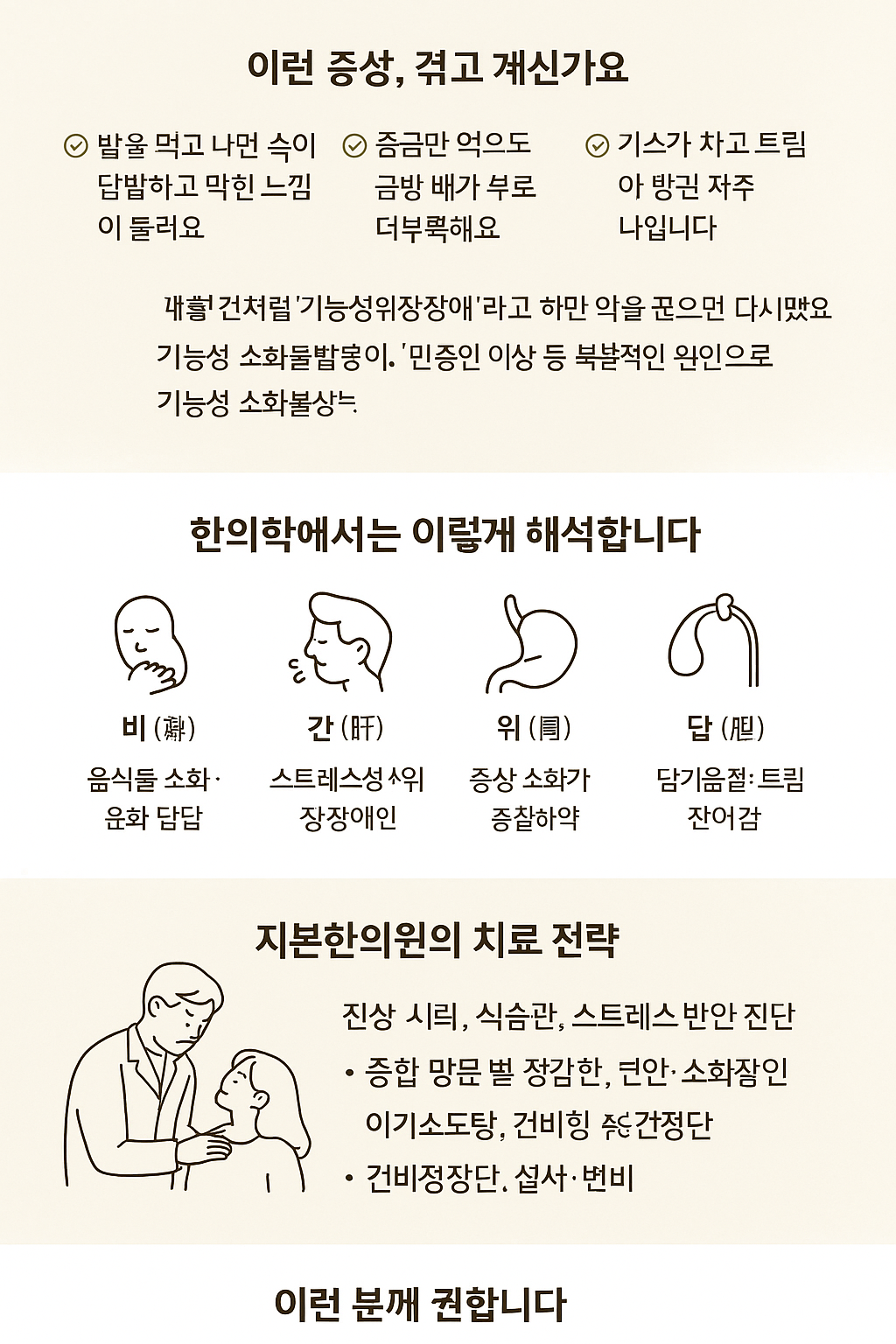
Korean Medicine (Hanbang/한방) views digestion as part of a whole-body system, not an isolated stomach issue. At Jibon Korean Medicine Clinic, we analyze digestive problems through three interconnected axes:
1. Autonomic Nerve Axis
In Korean Medicine, the Spleen (Pi/脾) and Stomach (Wi/胃) maintain an ascending-descending rhythm that directly corresponds to the sympathetic-parasympathetic balance. Chronic stress disrupts this rhythm, leading to gastroparesis-like symptoms without structural damage.
2. Blood Circulation Axis
Many patients with chronic indigestion also experience cold extremities and abdominal coldness. Korean Medicine identifies this as ‘Spleen-Stomach Cold Deficiency’ (Biwi Heohan/脾胃虛寒) — reduced microcirculation to the GI tract impairs enzyme secretion and peristalsis.
3. Inflammation Axis
Recurrent bloating and heartburn often indicate low-grade chronic inflammation of the gastric mucosa. The Korean Medicine concept of ‘Damp-Heat’ (Seupyeol/濕熱) aligns with modern understanding of gut microbiome imbalance and mucosal inflammation.
Real Experience — How Jibon Clinic Treats Digestive Disorders
| Treatment | How It Works |
|---|---|
| Personalized Herbal Medicine | One person, one prescription — each formula is tailored to your constitution and current digestive state |
| Acupuncture | Stimulating key points (Zusanli, Zhongwan, Neiguan) to restore autonomic balance and GI motility |
| Pharmacopuncture | Herbal extracts injected at acupoints to enhance microcirculation in the digestive system |
| Motae Hwangol Therapy (Chuna) | Integrated regulation of Jeong-Gi-Shin + 12 meridians + autonomic nerves + lymphatic circulation to relieve abdominal tension and normalize gut movement |
Clinical Note: A female patient in her 40s presented with upper abdominal bloating alongside neck/shoulder stiffness and insomnia. Rather than targeting the stomach alone, we regulated her entire autonomic nervous system. Within 4 weeks, her digestion normalized and sleep quality improved simultaneously.
Jibon Korean Medicine Clinic — Gwangju
Chief Director Kim Tae-gang (18 years experience, Sangji University Korean Medicine, Physiology Lab Researcher) — Musculoskeletal, Nervous System, Digestive Disorders, Motae Hwangol Therapy (Chuna)
Chief Director Noh Jeong-eun (22 years experience, Wonkwang University Korean Medicine, PhD in Herbology) — Autonomic Nerve, Circulation, Inflammation
Jibon Korean Medicine Clinic — Jeonju
Director Noh Young — Motae Hwangol Therapy (Chuna) Specialist
답글 남기기